|
* TinkerDifferent *
Retro Computing Community |
| Home | Forums | What's New | Search | Settings |
| Comm Slot II 10/100 Ethernet Cards |
|
Androda TinkerDifferent Board Secretary 2023 USA, Western -------- Joined: Sep 25, 2021 Posts: 523 Likes: 581 |
Jun 26, 2024 - #1
This is a stealth project I've been slowly working through for some time now. With Comm Slot II Ethernet cards being hard to come by, and often for high prices, it seemed like a decent target for recreation / re-engineering.
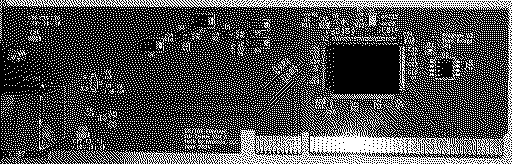
My approach here was originally going to be "remake the official Apple card" until I discovered that Farallon had made a 10/100 card. That sent me on somewhat of a research trip, digging into Ethernet hardware and compatibility for several weeks until I discovered a single-chip solution for 10/100 exists with wide Mac OS compatibility. The identity of this chip will not be revealed at the present time to ensure I can acquire a sufficient quantity of them. Having found a compatible chip, I ordered a PCI version of it and reverse engineered it with help from the chip's datasheet. Because in case people didn't know, Comm Slot II is PCI with fewer pins. Only one interrupt pin is available instead of four, there aren't the 64-bit transfer controls, things like that. Quite interestingly, despite being a 10/100 capable chip I'm only seeing about 150k per second max download speed (from Macintosh Garden) with the original PCI card installed in my G3 7300. There must be some degree of OS-side and extension-level driver handling which limits transfer speeds. But the hardware is capable of a 100 megabit link which should help compatibility with newer networking hardware that often doesn't like "plain 10". The Comm Slot II card reaches speeds of around 70 to 90k per second download on my 6400. It's not exactly a speed demon and I'm wondering whether anyone else has experience with CS II Ethernet cards to compare speeds. Maybe pulling files from a local FTP would be faster, haven't tested that yet. I can hear you clamoring for a picture, so fine. Chip numbers are redacted for reasons mentioned above.
Liked by eric,ClassicHasClass,PL212and 6 others |
|
Ron's Computer Videos Active Tinkerer -------- Joined: Oct 15, 2021 Posts: 199 Likes: 278 |
Jun 26, 2024 - #2
This is so great! Thank you, Androda! |
|
Action Retro Tinkerer -------- Joined: Oct 19, 2021 Posts: 50 Likes: 82 |
Jun 26, 2024 - #3
This is unbelievably cool!!
|
|
Trash80toG4 Active Tinkerer Bermuda Triangle, NC USA -------- Joined: Apr 1, 2022 Posts: 1,131 Likes: 329 |
Jun 26, 2024 - #4
Indeed! Love your work.
Thinking you could cram your design into a lower version of TAM/CSII riser's form factor? Looks simple enough in terms of parts count. Pigtailing the board to a panel mount connector for the backplane opening allows all kinds of tomfoolery! :) Not to mention opening your design to the well heeled TAM crowd, length of the standard CSII form factor is the only thing standing in the way of using that slot sans riser in the TAM. ;) edit: Wondering if pigtail -> CSII backplane breakout board notion might be preferable even for your targeted machines? Such would keep your design within the 10cm x 10cm SEEED square for economy's sake? How much does a six layer board in that format cost? Are you using six layers? |
|
Arbystpossum Tinkerer USA -------- Joined: Jan 8, 2024 Posts: 65 Likes: 39 |
Jun 26, 2024 - #5
Best of luck to you! Absolutely amazing.
|
|
Fizzbinn Active Tinkerer Charlottesville, VA -------- Joined: Nov 29, 2021 Posts: 256 Likes: 262 |
Jun 27, 2024 - #6
I agree on your comment about increased network switch compatibility of being 10/100 Ethernet regardless of any speed improvement over 10Mb/s half duplex Ethernet. ...but "150k per second"? Kb/s or or KB/s? 150Kb/s is slower than local talk (230Kb/s), 150KB/s (1200Kb/s) is 1.2Mb/s, well below even 10Mb Ethernet, maybe the limiting factor is Macintosh Garden or classic Mac OS TCP/IP stack? Local network tests could be interesting. Thinking about it I wonder if there is any info out there on Classic Mac OS Ethernet transfer speeds. I think Farallon provided a data transfer tool that could measure network transfer speed. I know I have a Apple 10/100 PCI card in my beige G3, could be interesting to figure some test scenarios. |
|
PL212 Tinkerer -------- Joined: Dec 25, 2022 Posts: 45 Likes: 30 |
Jun 27, 2024 - #7
I have an AsanteFast 10/100 card in my 660 and would be happy to contribute to any benchmarks... I'm sure the NuBus interface itself is the limiting factor there....
|
|
ClassicHasClass Tinkerer -------- Joined: Aug 30, 2022 Posts: 386 Likes: 215 |
Jun 27, 2024 - #8
Excellent work, especially since I'm out of CSII Ethernet cards between my TAM and 6500.
That said, I don't recall them being speed demons on either system. It did seem a little sprightlier in BeOS. |
|
Androda TinkerDifferent Board Secretary 2023 USA, Western -------- Joined: Sep 25, 2021 Posts: 523 Likes: 581 |
Jun 28, 2024 - #9
Help me understand what the TAM/CSII riser is for - two PCI slots in the TAM basically? I don't see an overall specifically stated "goal" of the project, or perhaps I'm blind and just didn't see it in the thread anywhere. |
|
Androda TinkerDifferent Board Secretary 2023 USA, Western -------- Joined: Sep 25, 2021 Posts: 523 Likes: 581 |
Jun 28, 2024 - #10
|
|
Androda TinkerDifferent Board Secretary 2023 USA, Western -------- Joined: Sep 25, 2021 Posts: 523 Likes: 581 |
Jun 28, 2024 - #11
|
|
Trash80toG4 Active Tinkerer Bermuda Triangle, NC USA -------- Joined: Apr 1, 2022 Posts: 1,131 Likes: 329 |
Jun 28, 2024 - #12
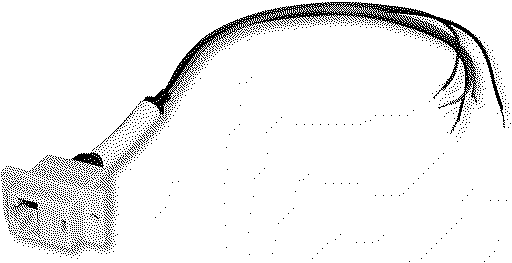
Thinking further about using your card in the TAM, it might work as is. Only the connector appears to be problematic. Been thinking you might just add provision for a Panel Mount connector/pigtail on the full length card or just leave it off in cards headed into the TAM. Something like this . . . . . . might be soldered into the connector's thruholes? Someone with a TAM might denude one of the useless CSII modems of its RJ11 to test if your full length card will be usable via pigtail in that machine when plugged directly into the logic board slot? Might be too long, but I'm hopeful. Apple's fumble fingered approach was limited by using the stock NIC in the TAM. The SkinnyBACK had no provision for anything to escape the case to the outside world. I cannot believe they removed its cooling fan from the FatBack spec! :rolleyes:
I'll be looking into recreating the ComSlot riser in the process if I can so folks will be able to use your new card in the old fashioned way if they don't have a riser already. One of the guys in AUS lacks that board, they seem to be in short supply? I'm almost entirely visual, so getting things across, making my thoughts clear in TXT is a difficult thing for me.
|
|
Androda TinkerDifferent Board Secretary 2023 USA, Western -------- Joined: Sep 25, 2021 Posts: 523 Likes: 581 |
Jun 29, 2024 - #13
Tested putting a 10/100 switch between this CS II card and my gigabit network, no change in download speeds from Macintosh Garden.
~100kB per second on the 6400 CS II running 7.6 using Netscape ~150kB per second on the 6400 CS II running 9.1 and iCab ~150kB per second on my 7300 original PCI running 9.1 and iCab Guess the driver just can't push it any faster. Though we do see that iCab seems to have the highest download speeds. |
|
Androda TinkerDifferent Board Secretary 2023 USA, Western -------- Joined: Sep 25, 2021 Posts: 523 Likes: 581 |
Jun 29, 2024 - #14
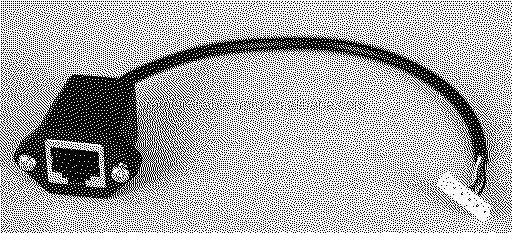
Are there panel-mount Ethernet ports that have the necessary magnetic components inside? The Ethernet jack I picked for this use case have that built-in, which decreases component count and thus cost. If not, then sure I could shorten the card and provide a header for a cable or similar to route to a port in the case. But then there would need to be a second PCB with the necessary magnetic components (or a magjack which has them included).
|
|
Trash80toG4 Active Tinkerer Bermuda Triangle, NC USA -------- Joined: Apr 1, 2022 Posts: 1,131 Likes: 329 |
Jun 29, 2024 - #15
|
|
Trash80toG4 Active Tinkerer Bermuda Triangle, NC USA -------- Joined: Apr 1, 2022 Posts: 1,131 Likes: 329 |
Jun 29, 2024 - #16
Now thinking that using the split off connector section would be optional. A proper panel mount connector could be hooked up the the same headers on the shortened main board?
|
|
Trash80toG4 Active Tinkerer Bermuda Triangle, NC USA -------- Joined: Apr 1, 2022 Posts: 1,131 Likes: 329 |
Jun 29, 2024 - #17
|
|
Mk.558 Tinkerer -------- Joined: Nov 11, 2023 Posts: 112 Likes: 45 |
Jun 30, 2024 - #18
I would recommend testing the card for throughtput/speed with local servers, specifically FTP and AFP. I've got a fairly reasonable span of example bitrates to compare against (but not much WAN testing unfortunately) on my website.
|
|
Androda TinkerDifferent Board Secretary 2023 USA, Western -------- Joined: Sep 25, 2021 Posts: 523 Likes: 581 |
Jun 30, 2024 - #19
I did try some FTP host software from the Garden but that only resulted in about 80kB per second download speed. |
|
Mk.558 Tinkerer -------- Joined: Nov 11, 2023 Posts: 112 Likes: 45 |
Jun 30, 2024 - #20
Oh I'd have no idea
FTP depends on which side you're doing it from. If you do it from OS X or Windows, the easiest is probably FileZilla Server if the built-in server is not an option. It only recently came out for OS X because starting in 10.13 High Sierra the built-in FTP server was removed and the ftp client in the Terminal was removed. (yikes on the last one...i'd have some serious reservations about that one.) If you do it from Mac OS side, I prefer and recommend NetPresenz -- simple, super easy to set up, literally less than 5 minutes, but if you're looking for beyond that it's not going to do as well as say, Rumpus. Modern AFP doesn't have to be complicated, as all the systems that ran AFP capped out a 1000BASE-T but mostly 100BASE-T. In any case, for Linux or inside a Linux VM, netatalk is the best option at the moment. Otherwise, I'd just use a OS 9/Jaguar/Tiger box. If you need more information beyond that, hollar. EDIT: Now that I'm thinking about this, I did a quick refresh on LEM's page on CommSlot ethernet / modem cards. Why not just make it compatible with CommSlot I and II? While making it compatible with 100BASE-T networks is viable, I checked ebay quickly (oh hey there's two iPrint LTs for 68$ for the pair...not bad if you can source your own power brick, which is pretty easy tbh) and there's one CommSlot I card up there. LEM does say the 100BASE-T CSII cards had compatiblity issues, but maybe they didn't have the same ethernet chip as yours does.
|
| Page 1 of 3 | Next > | Last >> |
| Home | Forums | What's New | Search | Bookmarks | RSS | Original | Settings |
| XenForo Retro Proxy by TinkerDifferent.com |
![[Image: icon_mrgreen.gif]](/proxy_image?url=https://forum.dd-wrt.com/phpBB2/images/smiles/icon_mrgreen.gif)
