|
* TinkerDifferent *
Retro Computing Community |
| Home | Forums | What's New | Search | Settings |
| Using the Sun to restore a yellow Macintosh [black-sun-with-rays] |
Forums > Vintage Apple > Macintosh > Compact Macs
|
-------- |
Jan 22, 2022
I've been looking at the safest ways to restore the color of the Mac without over bleaching the unit or leaving streak marks.
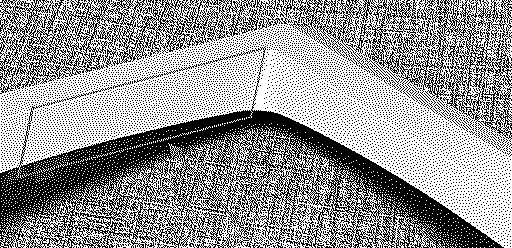
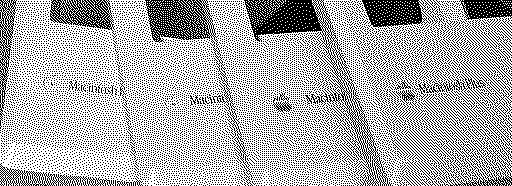
Because the inside of a Mac 128/512/Plus is coated with a conductive covering, I want to avoid submerging the case into hydrogen peroxide as it induces rusting/oxidation. I also want to avoid buying gallons of hydrogen peroxide. The two methods I tried were using just the sun (nothing else!), and a hydrogen peroxide cream. Here is a before/after gif of a platinum bezel using the two methods. Results OverviewAs seen in the gif, the center bezel is before and after. The bezel was place between a lightly yellowed bezel on the left and a heavily yellowed bezel on the right just for reference.The sun was able to restore the color to a modestly yellowed state. The creme did a much better job and was able to restore the color to a very slight yellowed state. I was impressed with both results in general Please note that the cream did NOT over brighten the bezel! From the area under the logo, you can see that the original color was even brighter. On the negative side for the cream. the bezel color was not evenly restored. On the left side of the inward CRT bend, there's extra yellowing, as highlighted in the image below. This is partially because it's difficult to get all the edges an equal amount of sun in such a short amount of time. Sun MethodBezel was placed outside in the sun, in the middle of January, every day between 11am and 4pm (I get limit sun due to surrounding buildings). 2 of the days were sunny and 3 days were cloudy. Temperature was cold, about 6*C/43*F every day. I did check on it everyday and on cloudy days the bezel would get brighter as well. I would place the bezel at slightly different angles every day to ensure all edges got some sun. Only the top side came out a bit darker, but this can be easily fixed by placing it at an angle to focus on top side.Below is an image of 4 Mac Plus platinum bezels. From left to right: 1. Original Color 2. Brightened via cream, original color can be seen where the logo was removed. 3. Brightened via sun for 5 days 4. Heavily yellowed bezel (right side bezel from above gifs) Lastly, I'd like to note that the 5 days of sun had no visible affect or discoloration on the badge, however I'm sure that if I did leave it out for a couple weeks it would. Cream MethodI followed the method described in this youtube video.Recipe (note this makes enough to do at least 5 macs!!):
ConclusionThe sun did a surprisingly really good job! However it seems you'd probably need to leave it out in the sun for a month if you'd like to remove most of the yellowing.The cream also did a great job, but it can be hard to get even results on a heavily yellowed bezel. My final suggestion would be to leave the case out for 1~2 weeks in the sun, and then follow up with a 1 hour cream treatment to get that extra final mile. Liked by davewongillies,JDW,baileyand 17 others |
|
Kai Robinson TinkerDifferent Board President 2023 Worthing, UK -------- Joined: Sep 2, 2021 Posts: 1,322 Likes: 1,313 |
Jan 22, 2022 - #2
Stickied this! :)
Liked by bcl,JDWandAndyDiags |
|
fehervaria Tinkerer North Germany -------- Joined: Sep 23, 2021 Posts: 160 Likes: 171 |
Jan 23, 2022 - #3
Very great summaries and extra thanks for the recipe for the "slime".
What is your opinion about a UV-A light bath? (UV-A is for example used for the PCB production or nail building). I would not mention the UV-C (used in medical area for desinfecting tools, rooms) because it is to agressive for anything. As I understand the temperature (6 Celsuis degree) is not an important factor "just" the Sun light, probably the UV light only? Could you let us know "where" are you on the North side of the Globe? Closeer to the Equator or far north? |
|
wottle Active Tinkerer Fort Mill, SC -------- Joined: Oct 30, 2021 Posts: 841 Likes: 577 |
Jan 24, 2022 - #4
Yeah, I've used just pure Peroxide creme (40vol) and reapply every 15-20 minutes (depending on how hot the South Carolina sun is that day). My goal is to keep the creme from drying in between coats. I also try to apply the brush strokes in opposite directions each time to try to minimize risk of streaking in one direction.
I do believe heat has a factor. I've noticed key caps respond much better to hydrogen peroxide when it is heated vs just left in the sun during the winter. I'm trying to get a cheap sous vide machine to help warm / circulate the hydrogen peroxide when the keys are in the tub. I used the cooktop on the lowest setting and over bleached some old keys... I feel like the more precise temp of the sous vide will make it easier to keep it simply warm. I tend to do my retrobrighting in the summer, partly because of the warmth, but also partly because you get a lot more sunlight to work with. I've seen some videos that compared UV alone vs UV with heat, and I thought I saw that the UV alone did not work well. I could be wrong, but I feel like I saw a YouTube video proving that during one of my Retrobright rabbit hole sessions. |
|
Paolo B Tinkerer Switzerland -------- Joined: Nov 27, 2021 Posts: 303 Likes: 182 |
Jan 24, 2022 - #5
Very interesting, thanks for sharing. I'm not a big fan of retrobrighting, I find the idea borderline OCD, but I agree the results can be extremely rewarding.
For boosting the effects of Sun (UV rays) and speeding up the reaction, I would try to seal the items into ozone filled transparent bags, which seems to be as effective as hydrogen peroxide. |
|
wottle Active Tinkerer Fort Mill, SC -------- Joined: Oct 30, 2021 Posts: 841 Likes: 577 |
Jan 24, 2022 - #6
Certainly something people can try, but so far hydrogen peroxide in the hot sun seems to be the most effective approach, if done with caution. |
|
JeffC Tinkerer Seattle, WA -------- Joined: Sep 26, 2021 Posts: 137 Likes: 88 |
Jan 24, 2022 - #7
I started a thread on another forum a while ago asking about retrobrighting indoors, and a user on that forum posted a photo of his indoor rig. He said he thinks it's more the heat than the light that causes the whitening. His rig consists of a large cooler with a 75 watt incandescent bulb inside, which keeps the temperature around 50-60c. He then puts the hydrogen peroxide mixture on the plastic and closes the cooler, he said he had good results after only 2 hours on a yellowed 512k case.
I didn't post a link to the thread since I'm not sure what the policy is as far as linking to other forums. If you google "Retrobrite indoors?", it should be the first non-reddit result. The 8th post in the thread has the info and a photo of his setup. Liked by wottle |
|
AndyDiags Tinkerer -------- Joined: Dec 18, 2021 Posts: 94 Likes: 167 |
Jan 25, 2022 - #8
I'm in Japan.
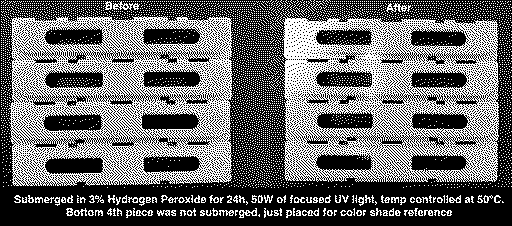
I very highly recommend using a sous vide when using dip method as it really helps distribute the heat evenly. The most common issue I found from my initial submersion tests was uneven heat causing streaks; a sous vide prevents this by providing a constant flow of water. Here's a sample indoor result. After 24 hour, yellow is still present, and leaving it any longer starts bleaching the whole piece to a different shade. To be honest, this looks comparable to the results I got just from leaving my Mac outside for 5 days.
Liked by Javmast3randwottle |
|
wottle Active Tinkerer Fort Mill, SC -------- Joined: Oct 30, 2021 Posts: 841 Likes: 577 |
Jan 25, 2022 - #9
|
|
Javmast3r Tinkerer -------- Joined: Oct 27, 2021 Posts: 70 Likes: 63 |
Jan 27, 2022 - #10
There's a lot of "Theories" about retrobriting, in my experience (more than a hundred items done for the past 6 years) I use the original formula, no youtube or amateurish methods. The original formula - that comes from an Amiga user and a Brazilian plastic engineer - uses CLEAR peroxide mixed with an oxigen enhancer and a thicker agent. It is applied over the plastic as a paint. It is left out on full sunlight, changing the angle avery few minutes and checking that the mixture does not dry. Cleanse and reapply is done throughout the process.
All the other "methods" are SHORTCUTS that people try to use to leave unattended and be lazy. The "sun process" is the latest of these lazy trends. The point of retrobrite is to have an exact process that will give you perfect results, but that takes time and effort. Every other way is a shortcut and may or may not have good results, leaving it to luck, fate and randomness. I don't mind people using their own plastics as test beds, just don't blame the original retrobrite method to their failed experiments. Just my 2cent Cheers Liked by XKSTEVEandPatrick |
|
Javmast3r Tinkerer -------- Joined: Oct 27, 2021 Posts: 70 Likes: 63 |
Jan 28, 2022 - #11
Liked by wottle |
|
AndyDiags Tinkerer -------- Joined: Dec 18, 2021 Posts: 94 Likes: 167 |
Jan 28, 2022 - #12
I also want to mention that I have health concerns about using the submersion method indoors. When I did try the submersion method, I ended up doing it outside due to the smell and large amount of hydrogen peroxide fumes created. Having a couple liters of hydrogen peroxide evaporate into your living area can't be good.
Liked by wottle |
|
ScutBoy Administrator Northfield, MN USA -------- Joined: Sep 2, 2021 Posts: 356 Likes: 342 |
Jan 28, 2022 - #13
I've put small things like hard drive cases as such out in the sun during the summer. It's slow, but it works. I've not seen any regression (or increased yellowing) on parts I did in the summer of 2020 when COVID started me being home during the day. YMMV
Liked by wottleandAndyDiags |
|
bwicklund New Tinkerer -------- Joined: Nov 24, 2021 Posts: 5 Likes: 1 |
Feb 2, 2022 - #14
Does anyone have experience using a UV Lamp? I am interested in doing a cream-less brighten but in MN in the winter the UV index is very very low.
|
|
davidg5678 Tinkerer -------- Joined: Oct 30, 2021 Posts: 60 Likes: 38 |
Feb 2, 2022 - #15
My (elementary) understanding of the chemistry involved is that hydrogen peroxide is comprised of only hydrogen and oxygen atoms. I think that when it decomposes, one of the extra oxygen atoms is released (as the gas bubbles). The remaining liquid just turns into plain water. If you use pure hydrogen peroxide, it's probably harmless --I couldn't say what's in the beauty product version of the chemicals though, so I wouldn't want to inhale those fumes. |
|
davidg5678 Tinkerer -------- Joined: Oct 30, 2021 Posts: 60 Likes: 38 |
Feb 2, 2022 - #16
|
|
bwicklund New Tinkerer -------- Joined: Nov 24, 2021 Posts: 5 Likes: 1 |
Feb 3, 2022 - #17
I was thinking about something like this: https://www.amazon.com/Sperti-Fiji-...ocphy=9019660&hvtargid=pla-599573796445&psc=1
I have some junk parts that I should test with first this thing is like a tanning bed so it puts out some serious UV. |
|
davidg5678 Tinkerer -------- Joined: Oct 30, 2021 Posts: 60 Likes: 38 |
Feb 3, 2022 - #18
|
|
bwicklund New Tinkerer -------- Joined: Nov 24, 2021 Posts: 5 Likes: 1 |
Feb 4, 2022 - #19
Well this is just what I have because Minnesota winters really zap your vitamin D.
My very un-scientific and ignorant question is this, if UV light is what causes the yellowing of these plastics over time then how is UV light alone helping restore the color on the plastics. Its not as dramatic as the HP but still he got results. |
|
AndyDiags Tinkerer -------- Joined: Dec 18, 2021 Posts: 94 Likes: 167 |
Feb 4, 2022 - #20
Liked by KingDingusanddavidg5678 |
| Page 1 of 6 | Next > | Last >> |
| Home | Forums | What's New | Search | Bookmarks | RSS | Original | Settings |
| XenForo Retro Proxy by TinkerDifferent.com |