|
* TinkerDifferent *
Retro Computing Community |
| Home | Forums | What's New | Search | Settings |
| Compact Mac Video Adapter |
Forums > Vintage Apple > Macintosh > Compact Macs
|
luminescentsimian Tinkerer Tucson, AZ -------- Joined: Nov 4, 2021 Posts: 126 Likes: 99 |
Jun 20, 2022 - #41
The Pi Pico's PIO units should be able to be clocked to sync up to with the Mac and easily get accurate pixel samples without having to oversample. Some math would be involved to figure out how to divide the system clock (48MHz) down to the pixel clock and setting the PIO unit to run at that speed. So it could do something like:
The second PIO can run the VGA or DVI code to output the frame buffer. I'm not sure how do mix in an overlay but some of the examples might have a method of doing it. The main CPU cores can mine bitcoin or something while the PIOs do the hard work. Or maybe talk to an ESP32 for WiFi and the VNC server. Oh, it probably needs a level shifter chip so the 5V video signals don't burn out the 3.3V inputs. Liked by -SE40-,alxlabandretr01 |
|
alxlab Active Tinkerer -------- Joined: Sep 23, 2021 Posts: 293 Likes: 323 |
Jun 20, 2022 - #42
Here's a link to the DVI sock PCB that someone might find useful:
https://github.com/wren6991/pico-dvi-sock Liked by Zane Kaminski,retr01and-SE40- |
|
-SE40- Tinkerer The Netherlands -------- Joined: Apr 30, 2022 Posts: 422 Likes: 168 |
Jun 20, 2022 - #43
@retr01 .... Its the main power & vid+sound connector on the mainboard ive shown before
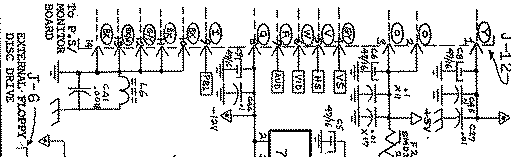
Here I did also find the schematics for the classicI/II confirming pinlayout to the Analog board-monitor section. I think of making a patch cable loom from my fully functioning CLII so I can experiment with a Pico Pi. (having a working 9" display)Then when in working order create a new PSU -Pico connector loom to the board?
|
|
Zane Kaminski Administrator Columbus, Ohio, USA -------- Joined: Sep 5, 2021 Posts: 372 Likes: 615 |
Jun 20, 2022 - #44
Another problem with the Pi Pico is that, uhh, I think I was confusing it with the Pi Zero back in February when we were discussing the oversampling algorithm. It would require some pretty tight code to keep up with transforming the oversampled pixels into the real 512 pixels on the Pi Zero's 48 MHz Cortex-M0+ CPU. The big RPis are much more capable so I don't think processing time would be an issue. But on the Pico, sampling at 48 MHz, we would have to process one byte of sample points every 8 clock cycles. Too tight for a 48 MHz C-M0+ I think. |
|
retr01 Senior Tinkerer Utah, USA -------- Joined: Jun 6, 2022 Posts: 2,474 Likes: 810 |
Jun 20, 2022 - #45
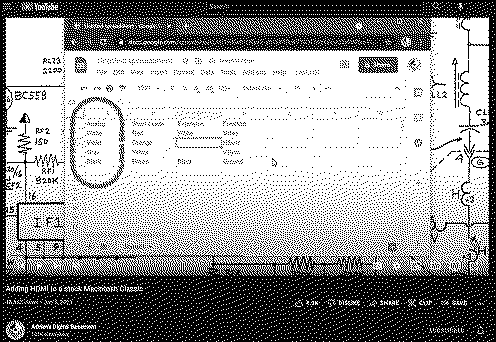
@-SE40-did you see the video by Adrian that I shared? He showed precisely where in the Classic to tap from the AB to get the video signal, as you indicated in that part of the schematic.
Unless you say there is another location on the Classic / Classic II LB where the video signals can be tapped?
|
|
-SE40- Tinkerer The Netherlands -------- Joined: Apr 30, 2022 Posts: 422 Likes: 168 |
Jun 20, 2022 - #46
@retr01 .... Yes!.....this is the cable that runs between the logic an analog board.
Grey - Violet - White At least that is what I have to look into. This is the easier place to connect cables into a Pi. But I have no analog/psu-monitor board and so pick up the signal from the mainboard. At least thats my idea to solve this. Plus I do not have the space lateron for an analog board. Liked by retr01 |
|
retr01 Senior Tinkerer Utah, USA -------- Joined: Jun 6, 2022 Posts: 2,474 Likes: 810 |
Jun 20, 2022 - #47
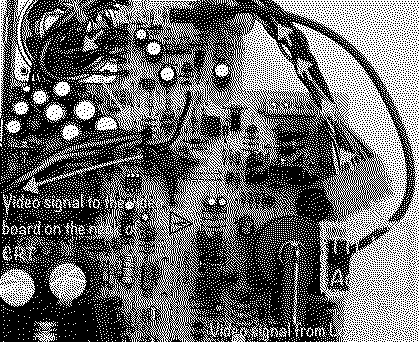
Ah! :D [idea] @-SE40-, it is also possible to tap the video between the connector on the LB and the harness to the AB by an adapter similar to the Power R 2703:
|
|
retr01 Senior Tinkerer Utah, USA -------- Joined: Jun 6, 2022 Posts: 2,474 Likes: 810 |
Jun 20, 2022 - #48
And now @Zane Kaminski, @alxlab, and @luminescentsimian are discussing using Pi Pico to convert the signal instead of RGB2HDMI (simple knife versus swiss army knife, other tools that are not needed). [grinning-face-with-s] Liked by -SE40- |
|
retr01 Senior Tinkerer Utah, USA -------- Joined: Jun 6, 2022 Posts: 2,474 Likes: 810 |
Jun 20, 2022 - #49
Liked by -SE40- |
|
-SE40- Tinkerer The Netherlands -------- Joined: Apr 30, 2022 Posts: 422 Likes: 168 |
Jun 20, 2022 - #50
Yes!
and so hoping for that should reduce (skip) the analog board section...as this is what is essential for a Classic II laptop version. Liked by retr01 |
|
retr01 Senior Tinkerer Utah, USA -------- Joined: Jun 6, 2022 Posts: 2,474 Likes: 810 |
Jun 20, 2022 - #51
|
|
-SE40- Tinkerer The Netherlands -------- Joined: Apr 30, 2022 Posts: 422 Likes: 168 |
Jun 20, 2022 - #52
[four-leaf-clover][check][four-leaf-clover]
Next I will check on the speaker connection. If there is an amplifier or such on the AB board |
|
luminescentsimian Tinkerer Tucson, AZ -------- Joined: Nov 4, 2021 Posts: 126 Likes: 99 |
Jun 20, 2022 - #53
I was thinking I could try out the idea with my Rainbow but it's video is composite not TTL and I don't have anything else old enough to generate these sorts of signals. Le sigh. |
|
Zane Kaminski Administrator Columbus, Ohio, USA -------- Joined: Sep 5, 2021 Posts: 372 Likes: 615 |
Jun 20, 2022 - #54
And yeah, I think 15.663240 MHz is close enough for one line. Only differs by 11 nanoseconds (i.e. 1/6 of a pixel) by the end of the 704-clock line. But how do we ensure we start the SPI transfer in the proper alignment with the video signal? We need to wait a precise amount of time after the HSYNC falling edge and then start the SPI transfer so as to align the centers (ish) of the correct 512 pixels in the middle of the SPI sample clock. It may be possible but any interference from other elements of the system will spell timing disaster. A pixel is 63.8 nanoseconds so that's 8.5 clocks wide at 133 MHz. Therefore we have something like a 4-6 clock range of time where the SPI transfer has to start so as to line up correctly at the middle of the line without getting too far off by the time the 11 nanosecond error accumulates at the end of the line. Liked by retr01 |
|
retr01 Senior Tinkerer Utah, USA -------- Joined: Jun 6, 2022 Posts: 2,474 Likes: 810 |
Jun 20, 2022 - #55
Morning! :)
It makes sense to use the software approach to over-sample and then process the output on the modern screen. Will that approach still create the exact (or close enough) replica of the original screen behavior and results? How about comparing Pi Pico to the R Pi Zero that the current RGB2HDMI adapter uses? If the Pico underperforms that over sampling is needed, does over sampling also happen with Zero in the current RGB2HDMI? |
|
retr01 Senior Tinkerer Utah, USA -------- Joined: Jun 6, 2022 Posts: 2,474 Likes: 810 |
Jun 20, 2022 - #56
One interesting observation by Adrian in his RGB2HDMI on Mac Classic video, a vertical line or two did not reproduce the cross-hatching correctly. :oops:
|
|
luminescentsimian Tinkerer Tucson, AZ -------- Joined: Nov 4, 2021 Posts: 126 Likes: 99 |
Jun 20, 2022 - #57
Hmm, may need to double the clock so there's time for a conditional JMP at the end of scanlines Liked by Zane Kaminski |
|
Trash80toG4 Active Tinkerer Bermuda Triangle, NC USA -------- Joined: Apr 1, 2022 Posts: 1,131 Likes: 329 |
Jun 20, 2022 - #58
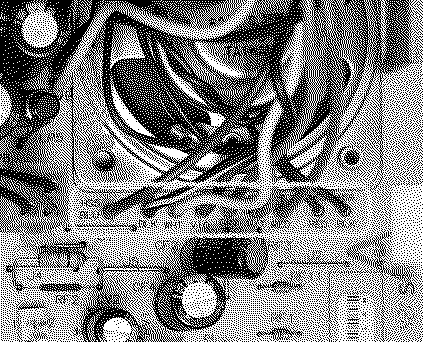
Didn't see any source material from the CatMac/Hackintosh days in the thread. I was moving documentation around today and misplaced the three PCB pics I'd associated with this article:
I'll try to find and edit the pics in later if you guys would like or not if you don't. IIRC TTL -> VGA is pretty simple, no? Maybe just for shiggles and gits if of no practical use in this project? :)
Liked by -SE40-andretr01 |
|
retr01 Senior Tinkerer Utah, USA -------- Joined: Jun 6, 2022 Posts: 2,474 Likes: 810 |
Jun 20, 2022 - #59
|
|
alxlab Active Tinkerer -------- Joined: Sep 23, 2021 Posts: 293 Likes: 323 |
Jun 21, 2022 - #60
It's from a book called Macintosh Repair & Upgrade Secrets
https://tinkerdifferent.com/resourc...e-secrets-for-models-128k-to-macintosh-se.42/ Liked by retr01 |
| << First | < Prev | Page 3 of 6 | Next > | Last >> |
| Home | Forums | What's New | Search | Bookmarks | RSS | Original | Settings |
| XenForo Retro Proxy by TinkerDifferent.com |