|
* TinkerDifferent *
Retro Computing Community |
| Home | Forums | What's New | Search | Settings |
| Apple Newton Keyboard X0044 analysis, revisions, USB conversion & how it's an IBM keyboard in disguise |
Forums > Vintage Apple > iPad, iPod, Newton/eMate & Handhelds
|
-------- |
Apr 16, 2022
Hello, Tinker Different!
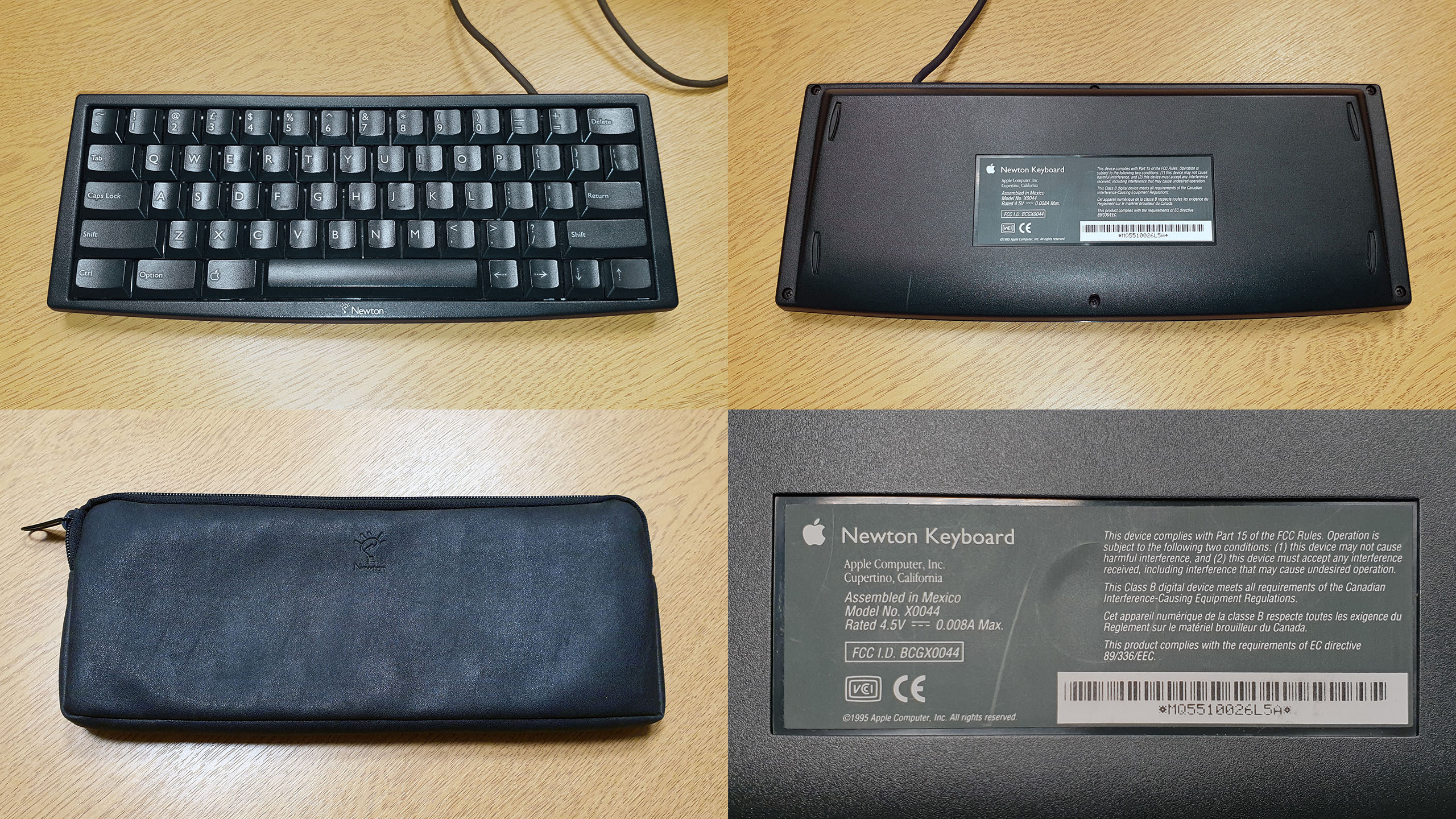
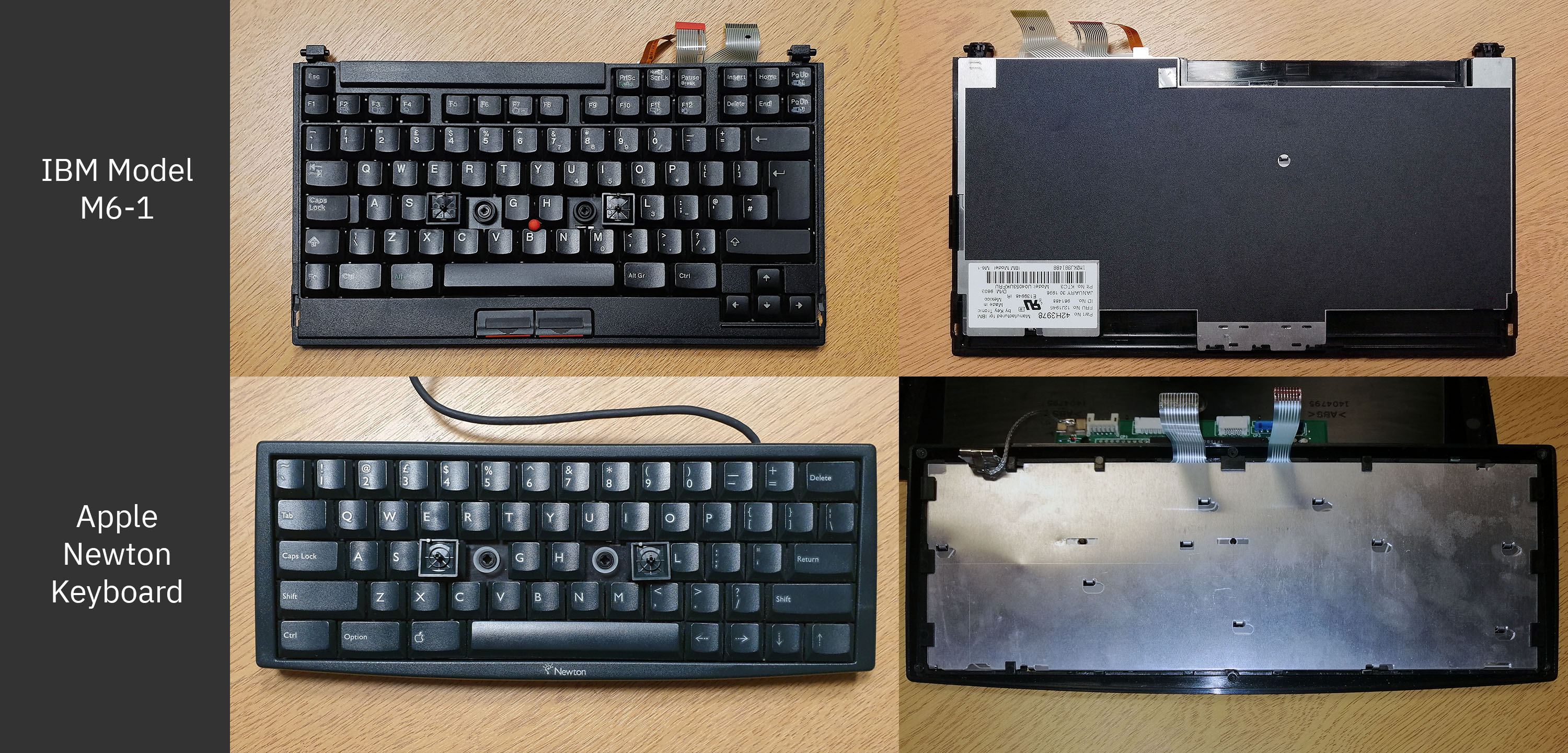
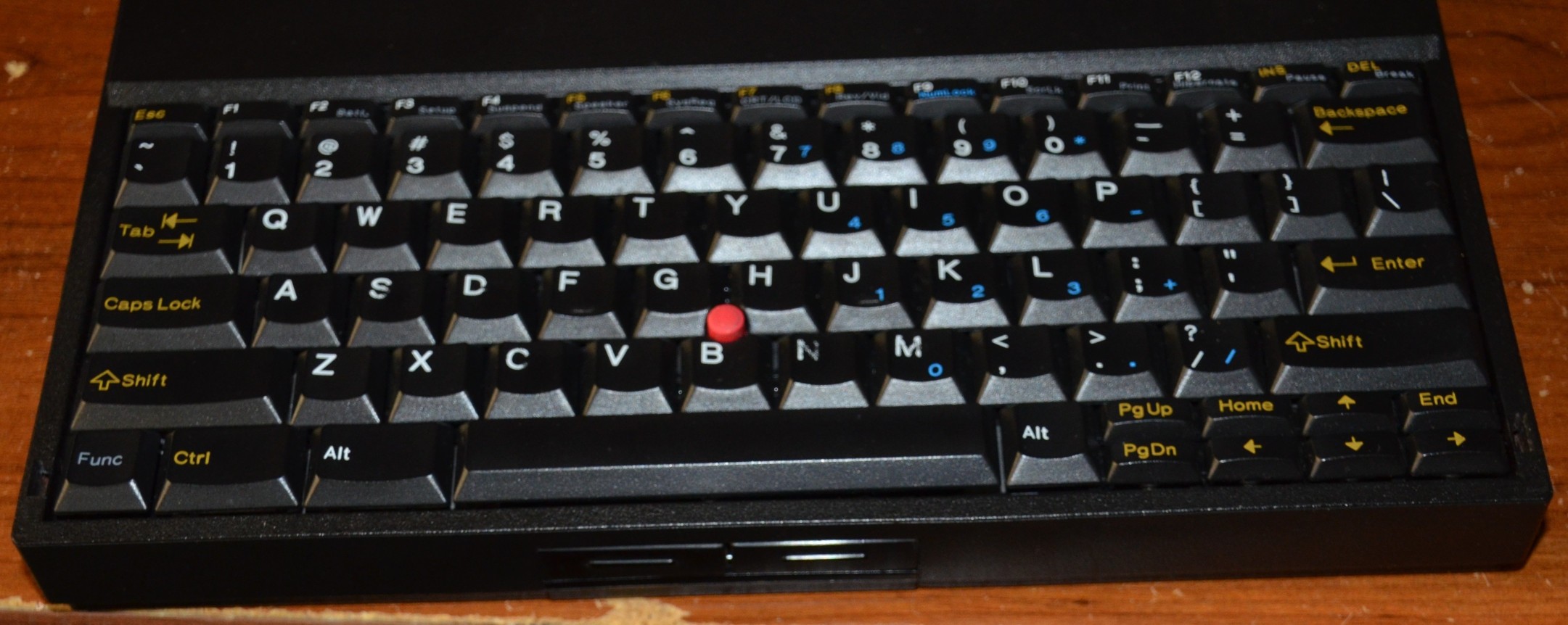
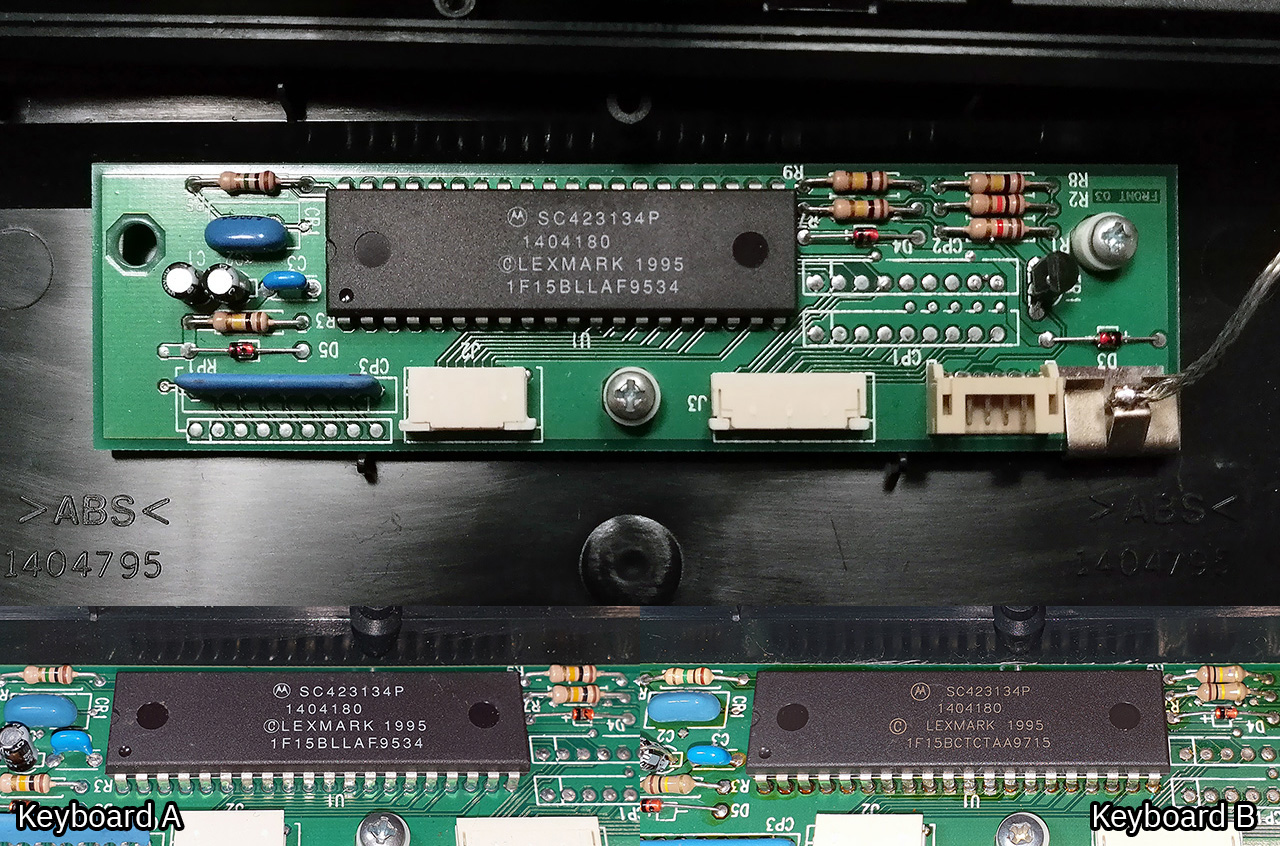
This is my first proper post here and it's going to be a big one, regarding the Apple Newton Keyboard (model X0044). I've written an article regarding the keyboard; including a brief tour around it, an explanation and evidence of how it's related to the IBM Model M keyboard family, a comparison of two discovered revisions, and pointers on how you can convert one to USB if desired! The article: https://sharktastica.co.uk/articles/apple_model_m However, the article was written with my typical audience in mind. As explained in my member bio, I'm mostly involved in the IBM keyboard space, so I appreciate some things may not make sense if you're not familiar with them. Thus, I've pretty much writing a tailored version below with extra historical context! :) Key facts will also be bolded as well. I appreciate this may be a lot to read, but I'm eager to contribute what knowledge I have and stuff I've found out! The keyboardThe Apple Newton Keyboard (hereon referred to as X0044 after its model name) was the keyboard intended for the MessagePad series - the eMate 300's keyboard is of a different design. The X0044 was also not available at launch as magazines from the time note its arrival in Q1 1996 with Newton OS 2.0 (and the keyboard itself has a 1995 copyright date). As alluded by the copyright information on the keyboard's Motorola IC (seen later), Lexmark is responsible for the keyboard's design.[Image: Photo a.jpg] So, Lexmark?Today regarded as the printer company that invented a lot of anti-consumer practices the printer business is known for, Lexmark has its origins in IBM. By August 1990, IBM had decided to spin off its US-based typewriter keyboard and printer manufacturing and created the IBM Information Products Corporation as a vessel for selling to investment firm Clayton & Dubilier. The company included IBM's manufacturing in Lexington, Kentucky and Boulder, Colorado. On 27th March 1991, the buyout was complete and Lexmark International was formed. IBM and Lexmark would be tied for the next 5 years as the two companies agreed that IBM would market most Lexmark products until April 1996, thus Lexmark become a major OEM for IBM.Of interest for this discussion, Lexmark became the primary OEM for IBM's portable computer keyboards worldwide and IBM's main OEM for keyboards in general for North America. As part of the buyout, Lexmark received IP for IBM's famed Model M family of keyboards. Whilst the family is widely known for its colossal clicky buckling spring keyboards, Model Ms encompassed other 'flagship' IBM keyboard designs irrespective of market or key-switch that by 1996 included the Models M3, M4, M4-1, M6, and M6-1 buckling rubber sleeves keyboards. The X0044 is a modified M6-1, meaning its lineage begins with the IBM PS/2 L40SX and subsequent ThinkPads. [Image: Photo b.jpg] M3/M4/M4-1/M6/M6-1For those familiar with Model Ms, you may already be familiar with M2 (IBM Selectric Touch Keyboard), M5 (IBM Trackball Keyboard) and the M13 (IBM TrackPoint II Keyboard). These keyboards fit within that sequential numbering scheme despite differing significantly. As alluded to, "Model M" does not necessarily equal "buckling spring keyboard". "Model M" was essentially used by IBM to denote a flagship keyboard for a given market. This Model M subfamily was IBM's flagship portable computer/low-profile keyboard offering (dates approximate):
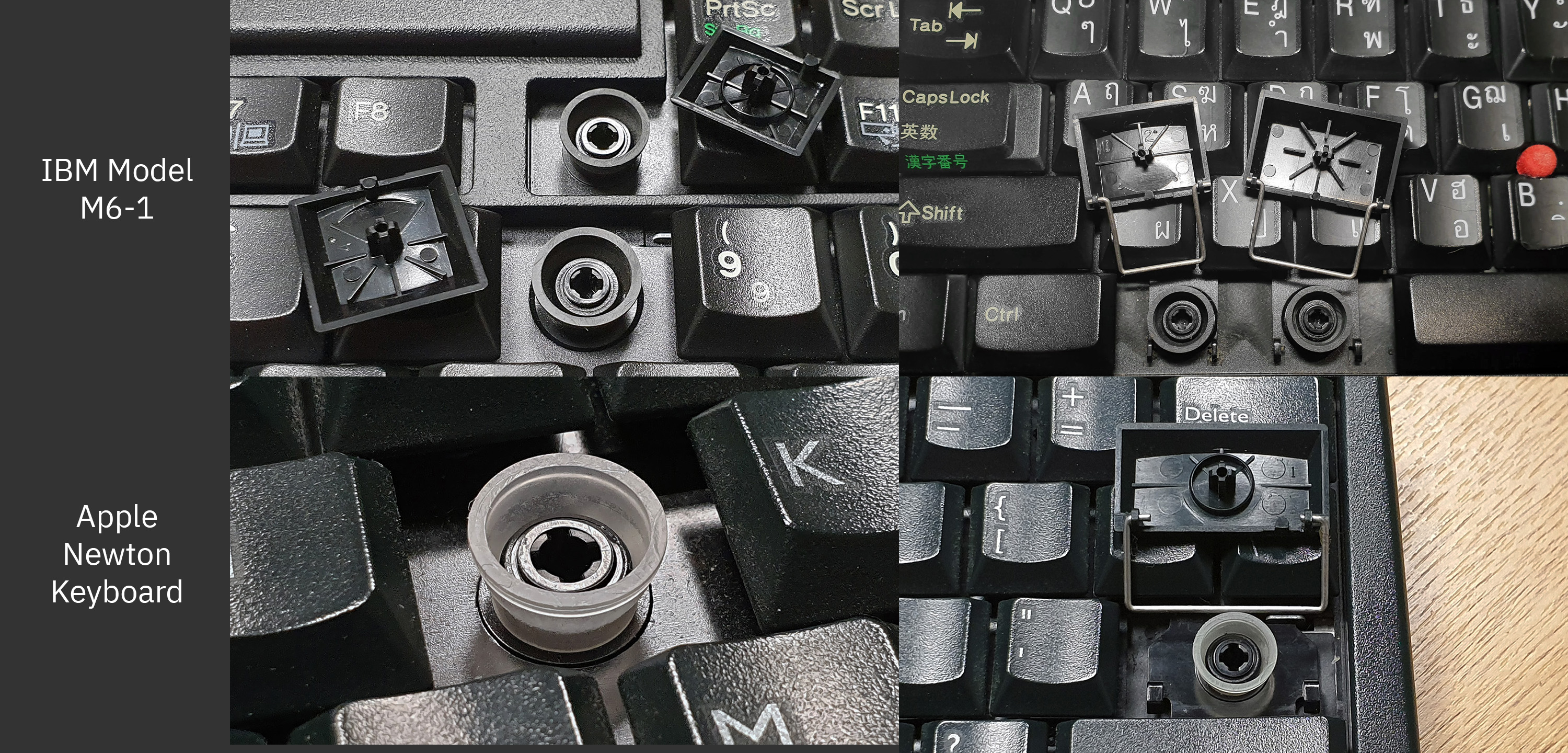
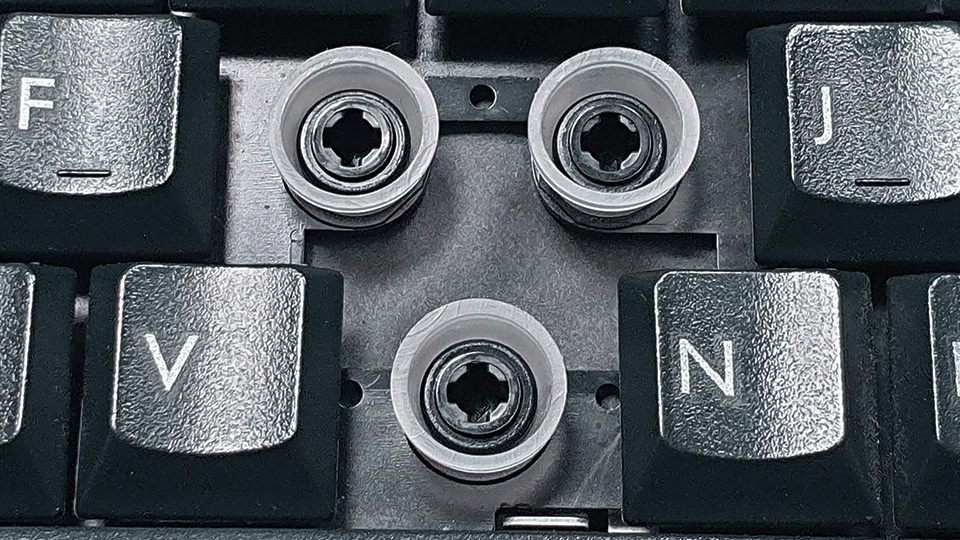
Buckling sleeve switchesIn keeping with their flagship status, these keyboards do not use 'common/standard' rubber dome or scissor-switch technology. The X0044 and the aforementioned Model Ms use what is now aptly referred to as "buckling rubber sleeve" key-switches since there are a few fundamental differences besides the obvious fact they're not dome-shaped. Typical rubber dome (over membrane circuit or PCB via conduction) switches will play a triple duty; they actuate the membrane on bottoming out, provide tactile feedback, and provide a force to return the keycap. The first fact is what allows for the mushiness feeling a lot of people associate with cheap rubber dome keyboards.Buckling rubber sleeves avoid this by having the rubber component sit externally to the keyboard assembly. Instead, a plastic rod on the keycap (M3/M4/M4-1) or a fixed barrel slider (M6/M6-1) is employed to provide a much more solid interface for actuation. Coupled with the fact the sleeves are sculpted so that the rubber at the top of the sleeve buckles to rest aside the bottom rubber instead of all squishing at the bottom, the 'mush' associated with rubber domes is avoided. In my opinion, the switch is snappy, crisp, tactile and depending on implementation can have considerably more key-travel than most laptop keyboards produced since the '00s. [Image: Photo e.jpg] If you're interested in learning more about this keyboard family the X0044 belongs to in more detail, here are some of my resources worth checking out:
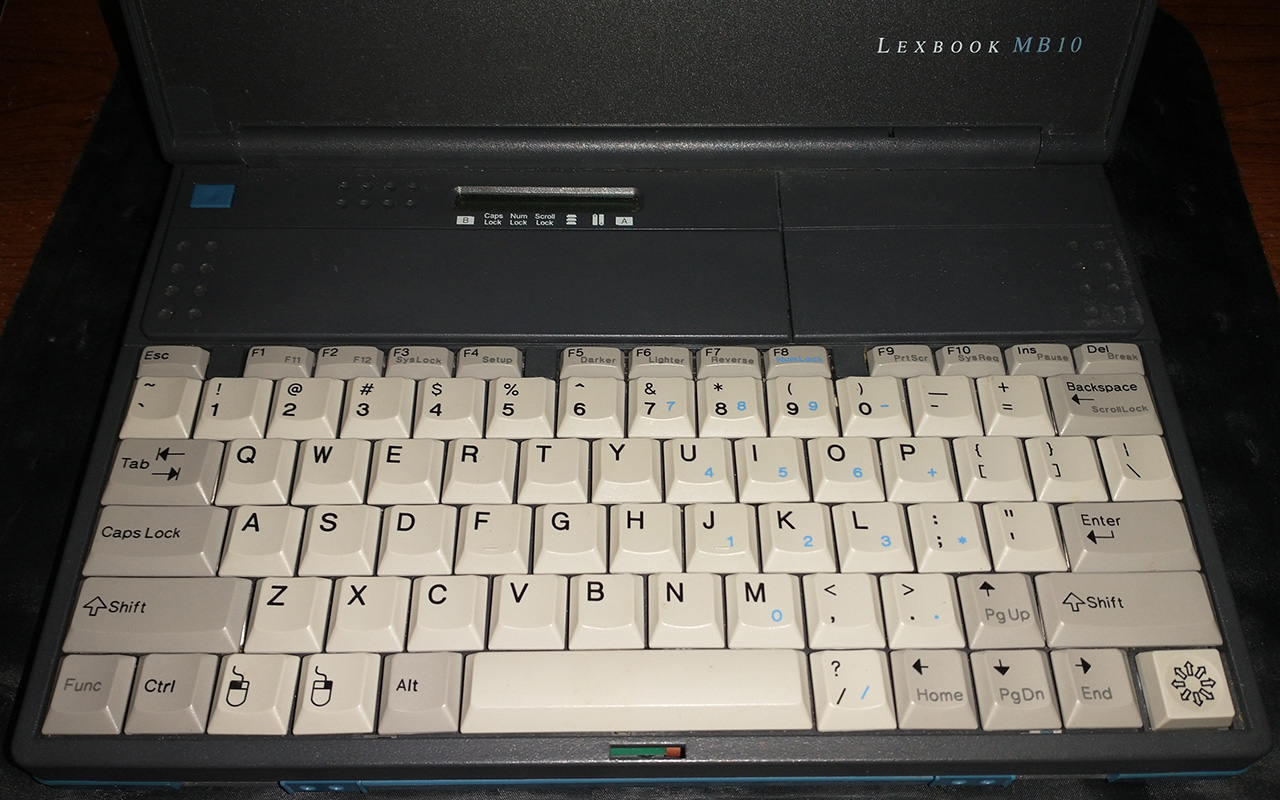
X0044's IBM and Lexmark relativesThe X0044's keyboard design is tied with the IBM ThinkPads 500 and 510CS and the Lexmark Lexbooks MB-10, MB-15 and SE-10. There are telltale signs, including specific size of the rubber sleeve component (better explained in the article itself) and especially for the Lexmark keyboards... notice that the bottom-right "mouse key" plus the padding around it matches that of the X0044's unusual up-arrow key?Lexmark Lexbook MB-10 (credits: Jack @ laptop.pics) Another observation is that the X0044 has a cutout for a pointing stick module on its upper assembly plate. [Image: Photo g.jpg] I've found no evidence that Apple was seriously considering using IBM's TrackPoint or Lexmark's alternative FSR stick in its design. Apple of the period preferred using trackballs in lieu of touchpads, something Lexmark could have accommodated if it wanted to (a snippit of a Lexmark advert showing its trackball keyboard option). Thus, it's likely just an artefact of what seems to be a reused but modified keyboard design. But yeah, other than layout, the only major difference is the deletion of F-keys. IBM ThinkPad 500 (credits: Jack @ laptop.pics) ObservationsSo yeah, I think that certainly establishes the X0044's origins so let's now talk about observations! Firstly, at least two distinct versions of the X0044 exist and I own an example of both. Here are the numbers:
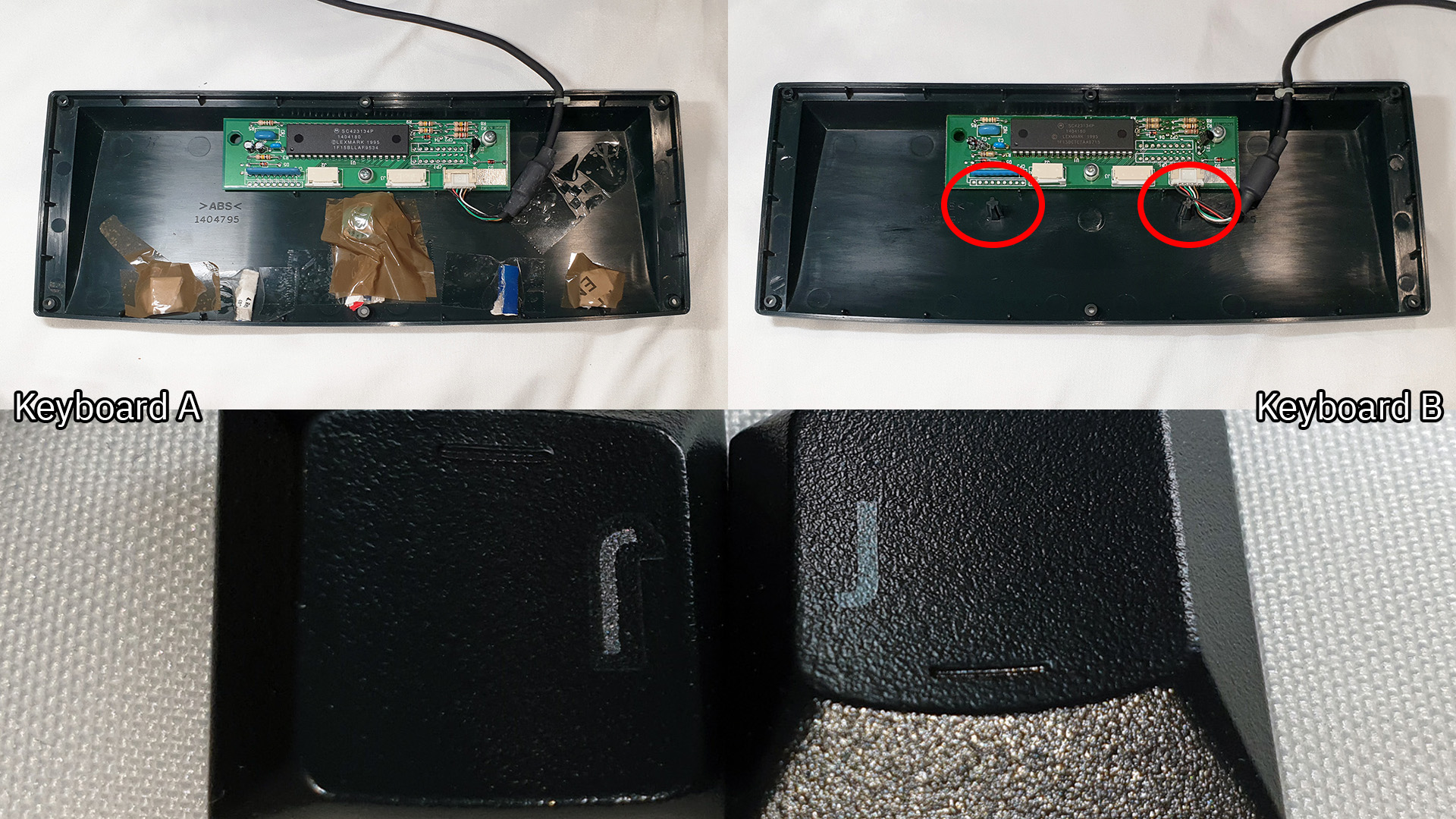
Also visible in the photo above is a stamp in the case that indicates it is made of ABS plastic. Note the four last digits of the IC number; it looks like a year and week code. Whilst I'm not 100% certain of this, from what I've seen of other Newton Keyboard examples this makes sense since ones with post 95xx numbers seem to have the revisions I found but 95xx examples do not. What are these revisions? There are two:
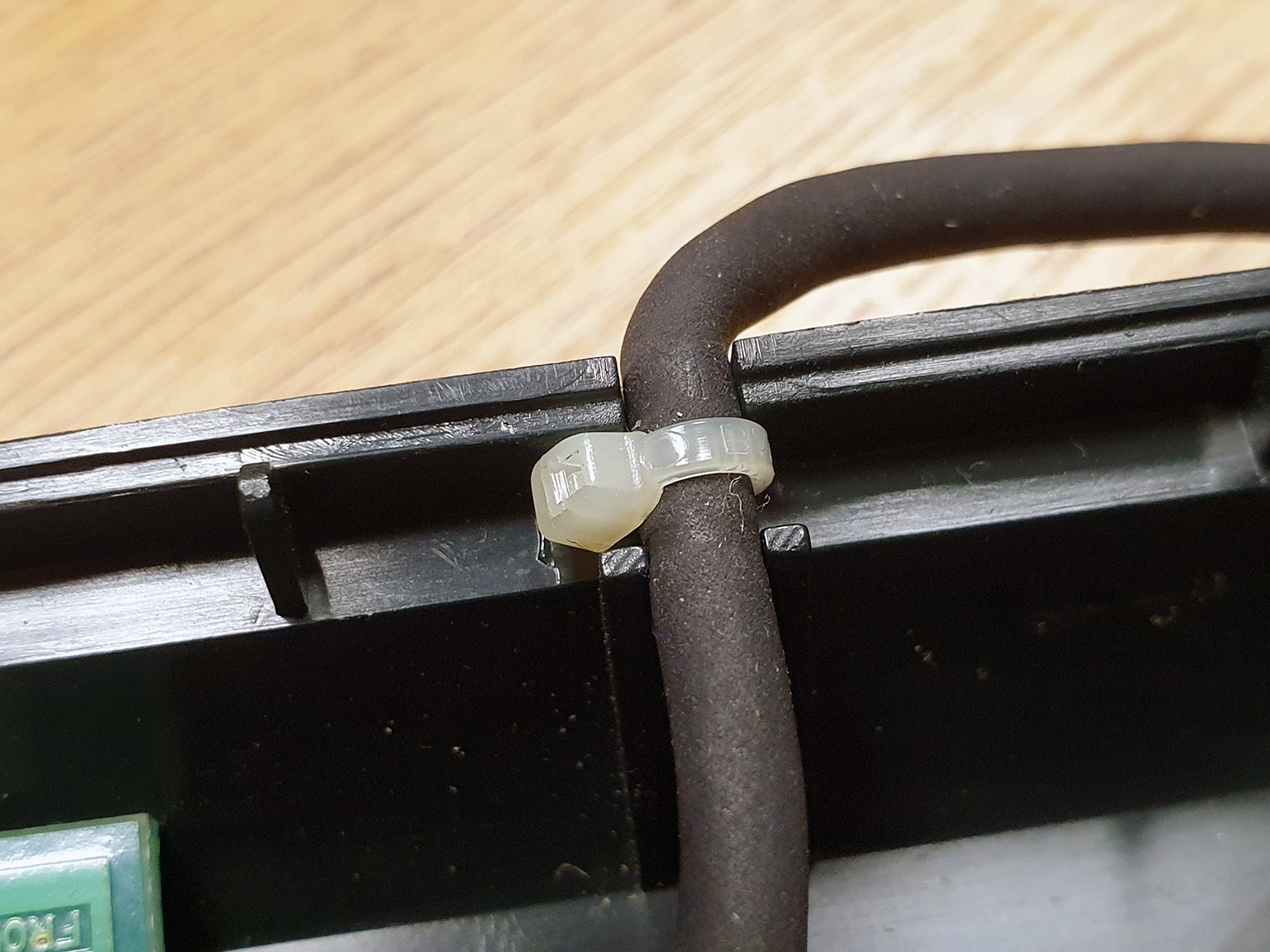
[Image: Photo j.jpg] The tape you see on Keyboard A was my 'quick and dirty' attempt to prevent the keyboard from flexing whilst I worked on a 3D printable support. Underneath the tape, there's layers of cardboard. Finally, I must bring to your attention the amusing cable retention system... a zip tie! I mean, if it's simple and it works, so be it! [Image: Photo k.jpg] Connectivity & conversionThe X0044 does not use ADB protocol or connector like other Apple keyboards of the period, instead, it uses a unique protocol via an 8-pin mini-DIN plug - the same physical plug used for Macintosh LocalTalk. However, this had already been figured out and people have long devised ways of converting these keyboards to work on other systems. For example:
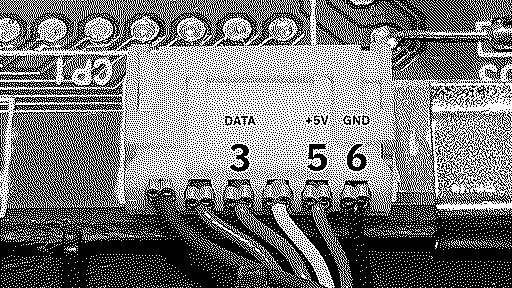
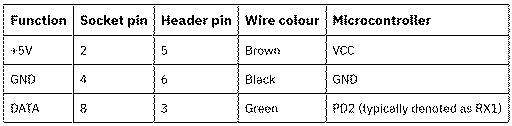
...and here's the cable header pinout: ...and finally the map table: In conclusion then...This keyboard is a very interesting piece of history even when you exclude the fact it's intended for such an interesting device as the Apple Newton. It's another taste of the Apple and IBM worlds colliding in the mid-1990s, something that probably could have never been imagined just a decade before. Other examples of this 'overspill' include the fact IBM was the OEM behind the PowerBook 2400c (although that doesn't use an IBM sourced keyboard design) and of course Apple's use of PowerPC processors from 1994 to 2006. Another example of how company-to-company relationships are not clear cut.For me in particular, this has been another interesting case study into how far the Model M family of keyboards actually penetrated the computing world. I usually use IBM's 1993 and onwards point of sale keyboards as the example of Model Ms in unexpected places, but this one is far cooler to think about! Anyway, I hope you learned something and enjoyed the read - cheers! Please let me know what you think! Note: I'll likely be updating this soon with some more information on the converter I assembled for one of these. Liked by Mac84,kaoshonen,JDWand 5 others |
|
Drake TinkerDifferent Board Vice-President 2023 -------- Joined: Sep 23, 2021 Posts: 449 Likes: 788 |
Apr 16, 2022 - #2
@splorp Could be an interesting topic for newton newsletter etc ;)
nice article and research as always! Someday I'll get my hands on some of this kit too :p Liked by splorpandAdmiral Shark |
|
Admiral Shark New Tinkerer Wales, UK -------- Joined: Mar 15, 2022 Posts: 7 Likes: 21 |
Apr 16, 2022 - #3
|
|
Kai Robinson TinkerDifferent Board President 2023 Worthing, UK -------- Joined: Sep 2, 2021 Posts: 1,322 Likes: 1,313 |
Apr 17, 2022 - #4
Stickied! :)
Liked by Admiral Shark |
|
splorp Tinkerer Calgary, Alberta -------- Joined: Oct 31, 2021 Posts: 167 Likes: 150 |
Apr 17, 2022 - #5
Great sleuthing @Admiral Shark! Liked by Admiral Shark |
|
splorp Tinkerer Calgary, Alberta -------- Joined: Oct 31, 2021 Posts: 167 Likes: 150 |
Apr 17, 2022 - #6
On a somewhat related note, here's a link to my Stowaway Keyboard Project (via the Internet Archive), in which several Newtonheads decided it was a good idea to connect a Stowaway foldable keyboard to the Newton.
(At some point, I'll rebuild the contents of the page on my live site.) In the meantime, here's my pinout diagram for mapping the Stowaway keyboard to the Newton serial port. Liked by Admiral Shark |
|
Admiral Shark New Tinkerer Wales, UK -------- Joined: Mar 15, 2022 Posts: 7 Likes: 21 |
Apr 18, 2022 - #7
Liked by BPearce |
|
Admiral Shark New Tinkerer Wales, UK -------- Joined: Mar 15, 2022 Posts: 7 Likes: 21 |
Oct 29, 2022 - #8
Minor update! I've since acquired a German ISO layout X0044 for study. Other than the expected differing key-switch position use, there were no other differences (such as manufacturing, tooling, nomenclature, etc.) worth mentioning. However, some of the current converter solutions don't support its ISO layout properly, so the TheMK and I are working on adding support to his TMK firmware fork. Once ready, I'll post another update.
Liked by chuma,splorpandDrake |
|
Admiral Shark New Tinkerer Wales, UK -------- Joined: Mar 15, 2022 Posts: 7 Likes: 21 |
Dec 9, 2022 - #9
Another update! tinkerboy.xyz is selling an Apple Newton X0044 keyboard converter for $39.99 USD. I'm not sure what firmware it's running, but my guess is TMK. I've also been developing my own modular keyboard converter system that's X0044 compatible that I plan to open-source when done. Presently in the prototyping stage with my sixth round of prototypes assembled this morning!
[Image: IMG_20221209_202450681_HDR.jpg][Image: IMG_20221209_203122187_HDR.jpg][Image: IMG_20221209_203330772_HDR.jpg] Anyway, TheMK and I still need to fix ISO support on his TMK fork. Will hopefully be done soon.
Liked by tinkerBOY,Mac84andsplorp |
|
tinkerBOY New Tinkerer -------- Joined: Mar 4, 2024 Posts: 2 Likes: 1 |
Mar 5, 2024 - #10
Liked by Drake |
|
Drake TinkerDifferent Board Vice-President 2023 -------- Joined: Sep 23, 2021 Posts: 449 Likes: 788 |
Mar 5, 2024 - #11
Liked by tinkerBOY |
|
tinkerBOY New Tinkerer -------- Joined: Mar 4, 2024 Posts: 2 Likes: 1 |
Mar 5, 2024 - #12
|
|
JDW Administrator Japan -------- Joined: Sep 2, 2021 Posts: 2,534 Likes: 1,981 |
Mar 5, 2024 - #13
|
| Page 1 of 1 |
| Home | Forums | What's New | Search | Bookmarks | RSS | Original | Settings |
| XenForo Retro Proxy by TinkerDifferent.com |

![[Image: Photo a.jpg]](/proxy_image?url=https://sharktastica.co.uk/resources/images/articles/apple_model_m/promotion/a.jpg)

![[Image: Photo b.jpg]](/proxy_image?url=https://sharktastica.co.uk/resources/images/articles/apple_model_m/promotion/b.jpg)


![[Image: Photo e.jpg]](/proxy_image?url=https://sharktastica.co.uk/resources/images/articles/apple_model_m/promotion/e.jpg)
![[Image: laptop-pics_mb10_keyboard.jpg]](/proxy_image?url=https://sharktastica.co.uk/resources/images/articles/apple_model_m/laptop-pics_mb10_keyboard.jpg)

![[Image: Photo g.jpg]](/proxy_image?url=https://sharktastica.co.uk/resources/images/articles/apple_model_m/promotion/g.jpg)

![[Image: laptop-pics_500_keyboard.jpg]](/proxy_image?url=https://sharktastica.co.uk/resources/images/articles/m3-m6_sleeves_laptops/laptop-pics_500_keyboard.jpg)

![[Image: Photo i.jpg]](/proxy_image?url=https://sharktastica.co.uk/resources/images/articles/apple_model_m/promotion/i.jpg)

![[Image: Photo j.jpg]](/proxy_image?url=https://sharktastica.co.uk/resources/images/articles/apple_model_m/promotion/j.jpg)

![[Image: Photo k.jpg]](/proxy_image?url=https://sharktastica.co.uk/resources/images/articles/apple_model_m/promotion/k.jpg)


![[Image: IMG_20221209_202450681_HDR.jpg]](/proxy_image?url=https://tinkerdifferent.com/data/attachments/10/10130-bd66da02ebb23eec2323ec5576538811.jpg)
![[Image: IMG_20221209_203122187_HDR.jpg]](/proxy_image?url=https://tinkerdifferent.com/data/attachments/10/10132-81684de6fb635684f4b64684cac76349.jpg)
![[Image: IMG_20221209_203330772_HDR.jpg]](/proxy_image?url=https://tinkerdifferent.com/data/attachments/10/10134-094bbada18bc67b5f9de8590521570a2.jpg)